Turnpike Folks Still Don’t Get The Folly Of Eastern Toll Road

Most people who are involved with road planning understand a simple truth.
YOU CANNOT BUILD YOUR WAY OUT OF CONGESTION!
The Florida Turnpike folks, however, still live in an alternative universe where building new roads makes congestion disappear.
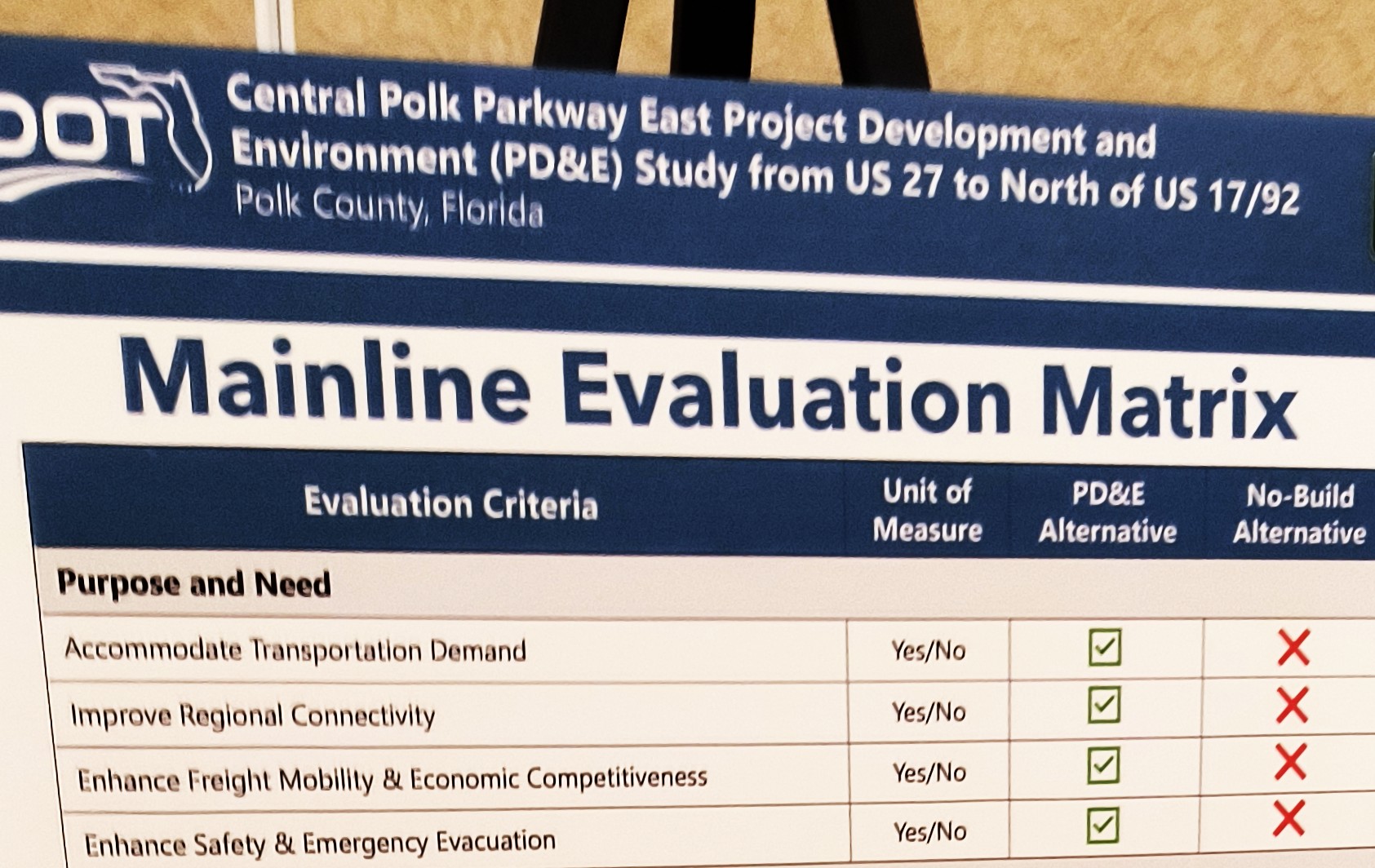
Anyway, that seemed to be the message on one of the information boards (see above) at the first of two open houses held to, provide information on a proposed toll road that will wind through eastern Polk County between the Dundee area and an area north of Davenport.
The next open house will be Thursday in Davenport from 5:30 to 7:30 p.m. at the Tom Fellows Community Center on North Boulevard.
There will be a formal public hearing sometime next spring on this phase of the road study, which is scheduled to wrap up later in 2027.
The main claim behind the push for this road is based on some indisputable facts, which is that U.S, 27 and other roads will become more congested in the future as more development occurs in that section of Polk County.
The question though is whether this detour is a cost-effective response.
It will be interesting to see what kind of origin-destination studies have been or will be conducted in addition to all of the other studies that will be required if this project is to proceed someday.
That is, will enough people actually use it to justify the hundreds of millions of dollars that will be involved.
There are other questions that are still unanswered such as how many homes and businesses will have to be bulldozed to make way for the road and how its presence will affect the management of nearby conservation lands and more.
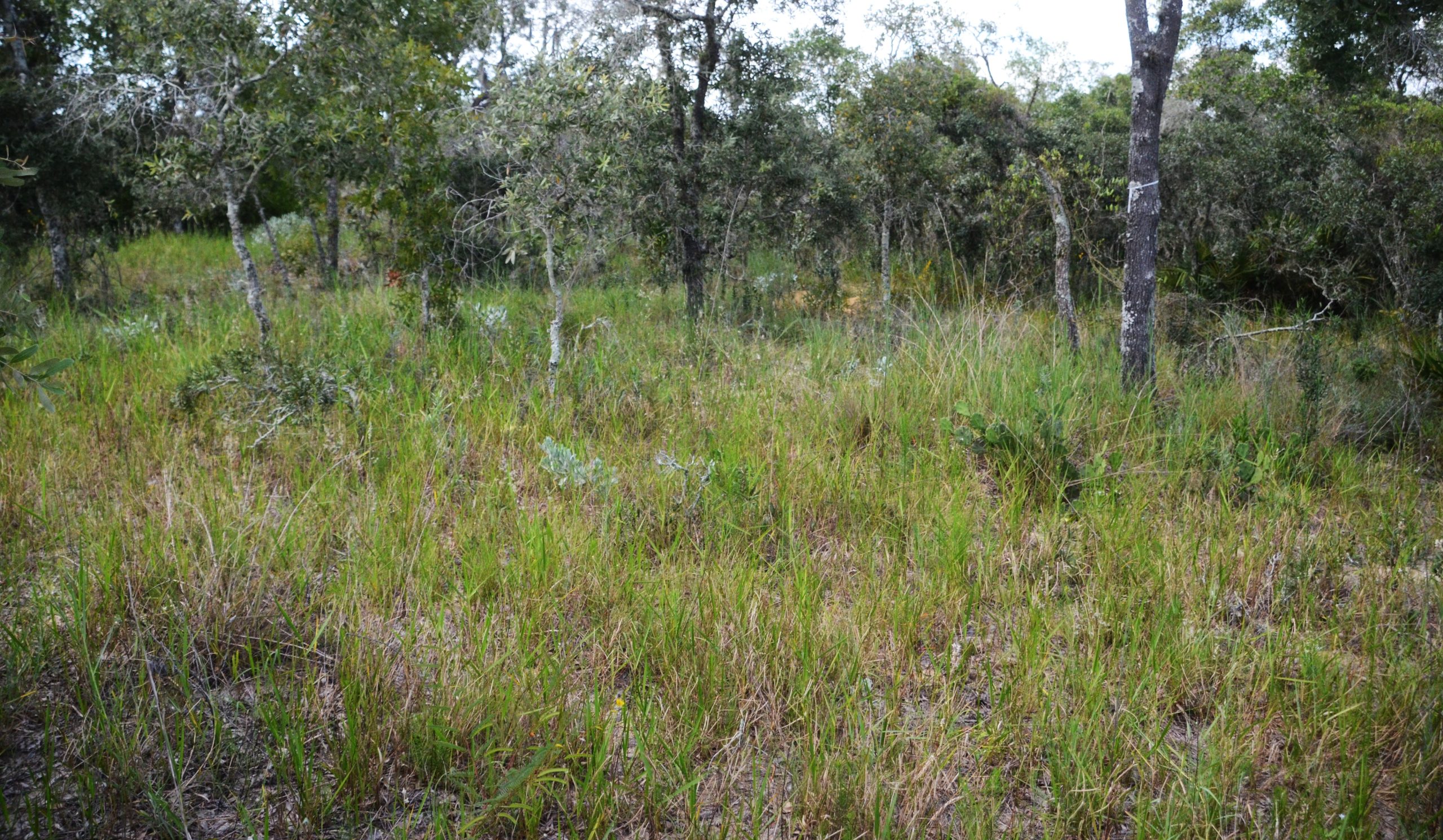
So far all they have used are the same tired rationalizations we read for every new project that comes along, accompanied by the claims about the harms that not building it will cause.
Transportation demand, real or imagined was discussed earlier.
Regional connectivity is another, though if you look at a current map, everything seems to be pretty well connected.
They talk about evacuation routes, ignoring the fact that the road will take motorists from one section of a congested highway system to another in a section of the state where they usually advise people to shelter in place. This also assumes this road will be congestion free.
Then there’s always the freight mobility argument, which put another way would mean there would be more truck traffic and air pollution coming to an area that has not had that problem in the past.
This project has been a boondoggle since it was first proposed more than a decade ago and it is still a boondoggle.
Support the NO BUILD alternative.
Polk Stormwater Management Enters New Era

Polk County Commissioners recently disbanded the Stormwater Technical Advisory Committee, which was part of Polk County’s long-delayed efforts to deal with stormwater pollution and flooding issues.
Dave Carter, longtime Winter Haven professional engineer who chaired the committee, said the decision was recommended by the committee because they felt they had accomplished their mission.
The committee was originally formed to oversee Polk’s drainage staff to make sure they were properly spending the recently approved Polk County stormwater tax in 2013 and initially included people who were critical of the tax.
As it turned out there was never any serious controversy about the projects the tax funded, all of which required County Commission approval anyway.
A lot of work involves monitoring pollution to comply with state and federal law, which was the catalyst for adopting the tax, which this year is .094 of a mill.
But it took a while to get here.
The County Commission had been dealing with flooding issues for decades and had commissioned and then ignored engineering studies recommending ways to deal with the issue, citing lack of money to implement them.
Sierra Club and other environmental organizations had pressed commissioners to do something about stormwater pollution, which was responsible for algae blooms and occasional fish kills on local lakes.
Commissioners did not formally discuss the idea of a stormwater tax or fee until 1990, but kept delaying action as other local governments such as Lakeland and Winter Haven enacted their own fees.
After an on-again. off-again discussion, commissioners finally acted.
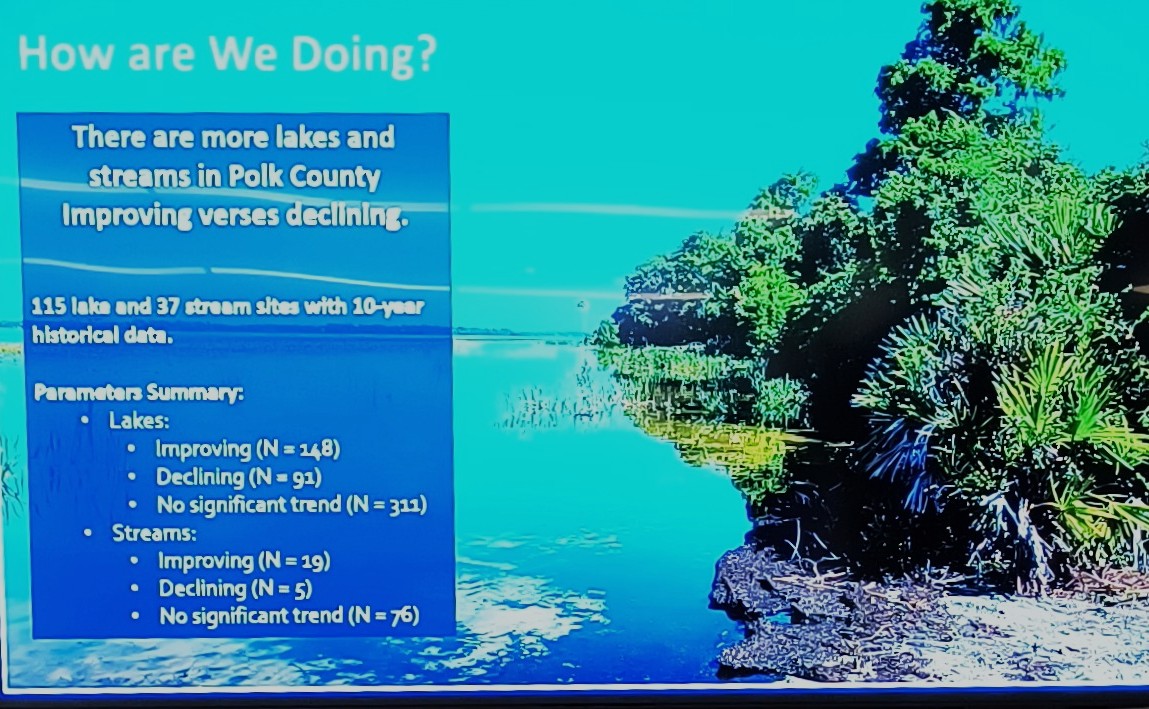
The results have been promising.
Water quality in many lakes and streams has improved and the tax, which sometimes attracted matching funds, was also used to complete some major regional projects such as the Lake Gwynn outfall in Wahneta and the Peace Creek Drainage Canal project in Dundee.

Polk Commissioners Agree To Buy Sandhill Site In Wildlife Corridor

A site containing 80 acres of undisturbed Florida sandhill habitat will become the latest addition to Polk’s environmental preserves, the County Commission agreed Tuesday .
Commissioners agreed to purchase the site on Masterpiece Road near Lake Wales for $3.6million from the Wheeler family, $3.1 million will come from the voter-approved Environmental Lands Program and $500,000 will come from the Department of Defense.
Tabitha Biehl, Polk’s Parks and Natural Resources Director, said an initial survey in 2025 found some listed species such as Sand Skink and Scrub Plum and more species may be discovered in future surveys after the property is acquired.
The property scored high when it was evaluated because of the lack of disturbance and almost total lack of invasive species.
It sits to the west of a piece of property Polk County officials are planning to develop as the site for a sewer plant and other county facilities.
Access to the property will occur through that site, she said.
There is no date set for when the site will open to the public.
This purchase complements a number of other purchases already approved or pending in the area along Masterpiece Road south of Lake Pierce that protect a portion of the Lake Wales Ridge, a chain of prehistoric desert islands that contain some of the highest concentrations of rare plant and animal species in the United States.

Hillsborough, Lakeland Officials OK Data Center Moratoriums; Polk Still Mum On Issue

The number of local governments in central Florida that have approved moratoriums on data centers continues to grow as Polk commissioners continue to remain mum on the issue.
The latest local government to approve a moratorium was the Hillsborough County Commission, which voted unanimously this week to put the brakes on data center applications to give their planning staff time to figure out what the rules should be if anyone submits an application.
This follows a similar action by the Lakeland City Commission on a 4-3 vote earlier this week.
The issues have been how water consumption will affect private wells and the environment, how developments will affect nearby communities because of the impacts of noise and air pollution, how the data centers’ energy demand will affect the local grid and power bills.
Additionally, concerns have been raised about the effects on environmental preserves and wildlife corridors.
Polk sort painted itself into a corner on the issue by approving a 10-year, $140 million property tax break on a proposed data center in Fort Meade before the issue became an issue.
For the record, Ancient Islands Chair Tom Palmer has addressed Polk commissioners twice on this issue and received no indication they are interested in addressing the concerns
Perhaps more voices need to be heard in Bartow as they have been in Lakeland and Tampa.